

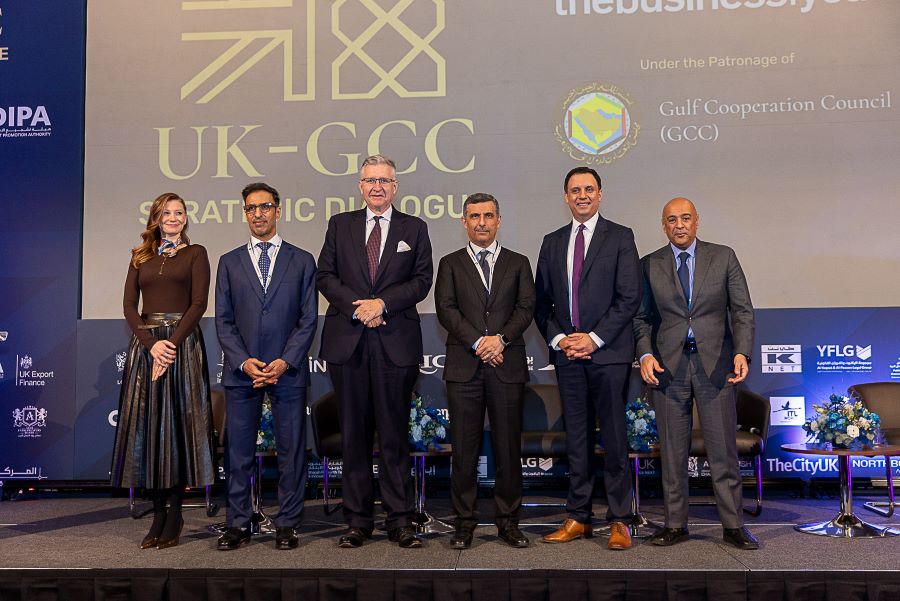
Guildhall, London, UK: The UK-GCC trade reached £53 billion in 2025 and Gulf sovereign investors deployed nearly $54 billion globally in the first half of 2026, the foundations for deeper investment cooperation are substantial.
This came as The Business Year hosted the UK-GCC Strategic Dialogue at Guildhall in London, bringing together senior representatives from government, financial institutions, investment organizations, and international companies at a pivotal moment in relations between the United Kingdom and the Gulf Cooperation Council.
The event, held under the patronage of the GCC General Secretariat, came five months after negotiations on the UK-GCC Free Trade Agreement formally concluded, placing the focus firmly on what comes next: how closer economic ties can translate into business opportunities, investment flows, stronger financial links, and new partnerships.
The morning began with welcome remarks and keynote addresses, setting out the wider political and economic context for the relationship. The opening session included HE Jasem Mohamed Albudaiwi, Secretary General of the Gulf Cooperation Council; Abdulaziz AlMarzooq, Minister of State for Economic Affairs and Investment and Acting Minister of Commerce and Industry of Kuwait; Lord Sarwar, UK Minister of State for Trade; Alderman Sir Alastair King, representing the Lord Mayor of the City of London; and Dr. Raja Al-Marzouqi, GCC Chief Negotiator.
Jasem Mohamed Albudaiwi reflected on the significance of the relationship at a moment when the two sides are preparing to move from agreement to implementation: “The economic partnership between the GCC and the United Kingdom is transitioning into a highly dynamic phase. This agreement significantly enhances mutual market access and lowers barriers, creating a competitive environment that encourages robust institutional investment and drives innovation across both regions.”
From the UK side, Lord Sarwar addressed the next phase of the trade relationship and the opportunities that closer engagement can create for businesses, telling attendees: “The UK-GCC Strategic Dialogue comes at a pivotal moment as we move toward signature of our recently concluded trade agreement. Bringing government and business leaders together is key to ensuring the deal supports more jobs, investment and opportunities for businesses across the UK and the Gulf.”
“I have a clear message: the UK is a long-term partner, ready to work with all six GCC states to deepen cooperation in high-growth sectors and deliver shared prosperity for all.”
The opening also saw Ioana Krempanszky Popa, Chief Commercial Officer of The Business Year, formally launch the accompanying publication, the UK-GCC Strategic Dialogue Special Report.
Following the opening remarks, the conversation moved to trade and investment promotion, with a discussion on how the new framework can support greater flows of trade and investment across the two regions.
Among the speakers, Eng. Nasser Al Kindi, CEO of Invest Oman, addressed the role of investment promotion in connecting international capital with the opportunities emerging across Gulf economies.
“The UK-GCC Strategic Dialogue comes at an important time to strengthen economic partnerships, deepen investment ties, and unlock new opportunities for sustainable growth across our regions. For Oman, a UK-GCC Free Trade Agreement could further enhance market access, encourage investment flows, and create new avenues for collaboration, reinforcing Oman’s position as a competitive investment destination and a strategic gateway to regional and global markets.”
“The opportunity now lies in connecting GCC capital with UK expertise in structuring and managing investments across infrastructure, private markets, and emerging industries. The UK-GCC Free Trade Agreement provides a framework to advance this ambition, with success ultimately measured by the quality of investments it enables,” Abdullatif W. Al-Nusif, Deputy CEO of Kuwait Financial Centre (Markaz), said.
Haitham Al Salmi, Chief Executive Officer of Muscat Stock Exchange (MSX), emphasized the importance of strengthening cooperation between GCC and UK capital markets to facilitate cross-border investment and enhance access to international capital. He stated: “As economic ties between the GCC and the United Kingdom continue to develop; capital markets have an important role to play in connecting investors with new opportunities and supporting long-term investment flows. At Muscat Stock Exchange, we are focused on deepening market liquidity, broadening our investor base, and strengthening international partnerships. Greater collaboration and knowledge exchange with UK financial institutions can further support the development of our capital markets and enhance their integration with global financial markets.
The exchange highlighted the growing importance of market infrastructure, liquidity, regulatory certainty, and international connectivity as GCC markets continue to deepen their links with global investors.
Attention then shifted to the digital economy, with a panel dedicated to the growth of digital trade, e-commerce, fintech, AI, and digital infrastructure across the GCC.
The discussion reflected how financial and technological infrastructure is becoming an increasingly important part of the wider UK-GCC trade relationship.
Sheikh Mohammed bin Jassim Al Thani, Chief Executive Officer of Edaa, joined Abi Ajayi, Head of Primary Markets for the Middle East and Africa at London Stock Exchange Group, for a discussion on the modernization of Qatar’s capital market infrastructure, post-trade systems, and international best practice.
“The UK-GCC Strategic Dialogue comes at a moment when global capital is choosing its partners carefully, and it is choosing those who can offer trust at scale. Qatar’s capital markets are being built on that principle, because strong post-trade infrastructure is what turns economic ambition into lasting investor confidence.”
As the UK and the GCC move toward implementation following the conclusion of negotiations on a Free Trade Agreement, The Business Year convened senior government officials, institutional leaders, investors, and private-sector executives at London’s Guildhall for a morning of discussion on trade, investment, finance, digitalization, and infrastructure.
