

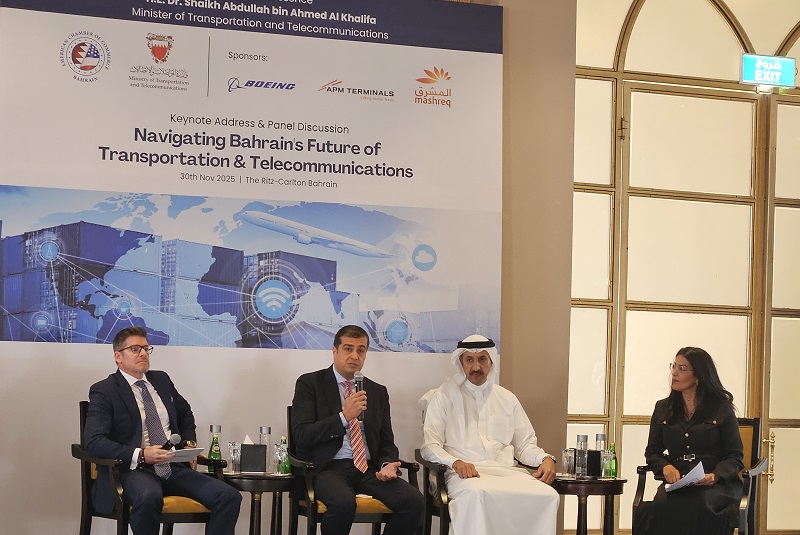
Manama : Mahmood Rafique, Editor : The Kingdom of Bahrain’s state-of-the-art new airport (BIA) and the world-class services catering for the needs for international airlines have repositioned Bahrain as traveler’s hub in the region, thanks to the Kingdom’s Vision 2030.
Bahrain International Airport (BIA) has elevated the Kingdom’s status as an emerging for travelers, tourists and cargo hub in the region. This was the crux of keynote address and panel discussion of AmCham Bahrain Chapter’s luncheon held at the Ritz Carlton titled Navigating Bahrain’s Future of Transportation and Telecommunication. The panelists were Dr Abdulla bin Ahmed Al Khalifa, the Minister of Transportation and Telecommunications, Wael Zaoud, Managing Director, Boeing Qatar, Matthew Luckhurst, CEO and Managing Director, APM Terminals Bahrain and moderated by Zahraa Taher, Board Secretary AmCham Bahrain.
HE Shaikh Abdulla, in his remarks, highlighted the salient features of the aviation strategy and said that the government would do everything possible to stay ahead among peers in this regard. The world-class services for international airlines at the BIA have been one of the key areas of priority over the years that have impacted positively and help not only retain the traffic but also show upward trends in all vital areas of sector’s growth.
HE also touched upon the importance of the ongoing infrastructure development n Bahrain including the phased metro project. Bahrain’s aviation Bahrain is making significant strides in developing its rail network as part of its Economic Vision 2030. The centerpiece of these efforts is the Bahrain Metro Project; a $2 billion initiative aimed at modernizing public transport and improving connectivity. The project will span 109 kilometers and be completed in four phases, with the first phase set to launch by 2027. Phase 1 includes two lines covering 29 kilometers and 20 stations, connecting key areas like Bahrain International Airport, Manama, Isa Town, Seef District, Juffair, and the Diplomatic Area. The system will feature elevated tracks, two interchanges, and fully automated driverless trains, designed to carry 43,000 passengers per hour.
The metro is being developed using a Public-Private Partnership (PPP) model advised by firms like KPMG, Egis, and DLA Piper advising on financial, technical, and legal aspects. The government has prequalified several international and regional consortia to bid on the project, including major players from China, India, and the GCC. The metro will also integrate with the planned GCC Railway, connecting Bahrain to Saudi Arabia via the King Hamad Causeway, further enhancing regional trade and mobility
Wael Zaoud, Managing Director, Boeing Qatar, said that he remembered once he was at the BIA and witnessed around two dozen different nationalities using the airport showing the vote of confidence in the services offer at the BIA.
To a question he said that Boeing and Bahrain working relationship goes back over decades and those have been improved significantly. It is worth noting that Boeing had signed a significant deal with Bahrain on July 17, 2025, when Gulf Air, the national carrier of Bahrain, agreed to purchase 18 Boeing 787 Dreamliner aircraft in a $4.6 billion agreement. The deal includes 12 firm orders and options for six additional jets, part of Gulf Air’s fleet modernization strategy to expand its international network. This agreement was finalized during an official visit by Bahrain’s Crown Prince Salman bin Hamad Al Khalifa to Washington, D.C., emphasizing the strengthening trade and aviation ties between Bahrain and the United States.
Matthew Luckhurst, CEO and Managing Director, APM Terminals, said that APTM Terminals Bahrain plays a pivotal role in driving the Kingdom’s trade by operating Khalifa Bin Salman Port (KBSP), Bahrain’s sole commercial port, which handles 100 per cent of the country’s commercial cargo shipped by sea.
