

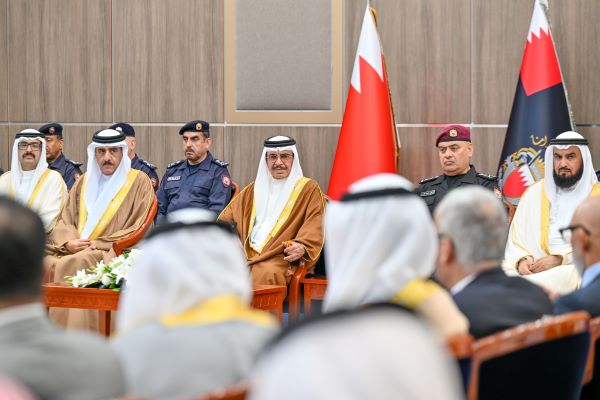
MOI: His Excellency Interior Minister General Shaikh Rashid bin Abdullah Al Khalifa met on Tuesday with citizens from different segments of society as part of the Community Partnership Strategy and to strengthen interaction with Bahraini society.
At the beginning of the meeting, he delivered the following remarks:
In the name of Allah, the Most Gracious, the Most Merciful
Praise be to Allah, Lord of the Worlds, and prayers and peace be upon our Prophet Mohammed, his family and all his companions.
Distinguished attendees,
Peace, mercy and blessings of Allah be upon you.
At the outset of my speech, I am pleased to express my thanks and appreciation to you for accepting the invitation to attend this meeting, which is being held in light of the repercussions of the Iranian aggression.
I affirm that the security and stability of the Kingdom of Bahrain are, after the grace of Allah, due to the wisdom, firmness and leadership of His Majesty King Hamad bin Isa Al Khalifa, the Supreme Commander of the Armed Forces. HM the King has laid the foundations of the state and strengthened our national defence and security capabilities, forming a strong barrier to protect the nation and achieve stability.
I should also highlight the decisive and integrated measures taken by the esteemed government, led by His Royal Highness Prince Salman bin Hamad Al Khalifa, the Crown Prince and Prime Minister, to address these emergency circumstances.
Distinguished attendees,
I take this opportunity to speak to you in detail about the blatant Iranian aggression against the Kingdom of Bahrain and the Gulf Cooperation Council states. This requires a historical reading of the Iranian regime grounded in Wilayat al-Faqih ideology.
This ideology did not stop at the limits of religious references; Khomeini transformed it into a cross-border political project, in which allegiance and obedience were directed to the Wali al-Faqih in Iran.
Accordingly, the political affiliation of followers of the Wilayat al-Faqih ideology is no longer linked to the state in which they live, but rather to the ruling jurist in Iran, as the source of political authority and obedience. This ideology has also turned citizens of any country into individuals subject to the authority of the Iranian Wali al-Faqih, even when such submission conflicts with their nation’s interests or harms their state’s security and stability. Let it be clear that there is no authority above the authority of the civil state in the Kingdom of Bahrain.
Returning to the core of the matter, Bahrain and the regional countries have witnessed a change in Iranian policy since the outbreak of the revolution in 1979, and blatant interference in Bahrain’s internal affairs. The first of these was the failed attempt to overthrow the government in 1981. This was followed by the acts of rioting and terrorism that the Kingdom of Bahrain witnessed during the 1990s, when Iran incited its proxies within the Shiite community and worked under a sectarian cover to push them to move against the state, portraying this as a duty required by obedience to the Wali al-Faqih, in addition to excluding and terrorising those who differed with them on jurisprudential and political matters. (Shaikh Salam Al Madani)
When HM the King took over the reins of government in 1999, he introduced a pioneering national vision, opened his heart to all, issued a comprehensive pardon for those who had acted against the interests of the nation, allowed those living abroad to return, granted them Bahraini citizenship, and launched democratic life in Bahrain. The comprehensive reform project became tangible across various aspects of life, preserving human dignity through the vote on the National Action Charter and the promulgation of the Constitution.
This surpassed and confused Iran’s plans and those of its proxies in Bahrain. Iran, therefore, worked to infiltrate the Shiite community and plant its jurisprudential cells through the judicially dissolved Islamic Scholars Council (Olamaa) as the jurisprudential arm and the dissolved Al Wefaq Society as the political arm.
When Iran’s proxies withdrew from the Council of Representatives in 2011, this was a matter that must be examined carefully. At that time, national figures from the Shiite community shouldered their patriotic responsibility and participated in the by-elections despite the threats and intimidation they faced. Iran then realised that its plan had not been completed, and that there remained members of the Shiite community in Bahrain who did not submit to its political and jurisprudential authority. They deserve our sincere thanks.
Distinguished attendees,
Recent incidents have revealed the true nature of individuals and distinguished between those who chose loyalty to the nation and those who chose to stand with its enemies.
Now that matters have reached this level, no citizen can forget what we witnessed from some individuals who celebrated and supported the hostile Iranian bombardment of the Kingdom of Bahrain. The situation was dealt with swiftly and immediately by revoking their Bahraini citizenship and deporting those who betrayed the nation to the place that encouraged them to commit such betrayal.
In reality, that moment marked a turning point in our security measures. Previously, our response remained within the limits of the crime and those who committed it, out of consideration for others, and by that, I mean consideration for you. However, it became necessary to adopt a root-level approach and deal decisively with Iran’s proxies in Bahrain, who formed the main group linked to Wilayat al-Faqih and the Iranian Revolutionary Guard Corps.
This group included individuals in Iran who served as links to the Iranian Revolutionary Guard Corps. The group was built around members of the dissolved Islamic Scholars Council. It is not a new group; we have been patient with it over the years and addressed the matter through reform, forgiveness, tolerance and pardon. However, they continued their destructive plans.
Its members worked to hijack the national will within the Shiite community, terrorise those who opposed their ideology, collect large sums of money and hide them in their homes for use in financing terrorist acts and sending them abroad for terrorist purposes. A sum of BD600,000 in cash was found in the home of one of those arrested.
They also infiltrated mosques and community centres (Maatams) whose administrations belong to well-known families that had built them. Today, however, those families have been intimidated and removed from their administration, while Maatams have been turned into centres for recruitment and ideological promotion.
This is in addition to exaggerating social and economic problems, building loyal militias through the Iranian Revolutionary Guard Corps, training them in camps prepared for this purpose, supplying them with weapons and explosives, enabling them to carry out smuggling operations, and infiltrating education, media and social media platforms to spread the Wilayat al-Faqih ideology.
Furthermore, they conducted disinformation campaigns, fuelled sectarianism and sought to sow discord within Bahraini society. Is this not a crime against the nation?
Distinguished attendees,
We have noticed claims being promoted on social media alleging that Bahrain’s Shiites are being targeted. This claim is completely rejected.
The Shiite community is an integral component of this country’s past, present and future. This has been affirmed by the Constitution and the laws, which make no distinction between citizens. The security and safety of all citizens remain the top priority.
Bahrain’s Shiites, in all cases, are older than Wilayat al-Faqih and have historically followed various Shiite religious references, and you know this better than anyone.
Our work will continue to clean the security landscape of those who harm the nation to serve those who have committed aggression against us.
We pray to Allah Almighty to protect the Kingdom of Bahrain and its blessings of security, prosperity and success under the leadership of the builder of our blessed renaissance, HM the King.
Peace, mercy and blessings of Allah be upon you.
This was followed by the attendees affirming that the people of the nation stand united behind the leadership of HM the King, renewing their pledge of loyalty and belonging, and their commitment to continue working with utmost dedication to preserve security and public order.
They stressed that such national cohesion is a fundamental pillar in facing challenges, noting that Bahrain’s security and stability are red lines that cannot be compromised. They affirmed that the nation remains above all considerations, as a responsibility entrusted to all.
The attendees also commended the efforts and sacrifices of security personnel in maintaining community security and protecting national achievements. They noted that the current phase requires national unity, particularly in light of the regional challenges facing the area, which call for greater awareness and national responsibility.
