

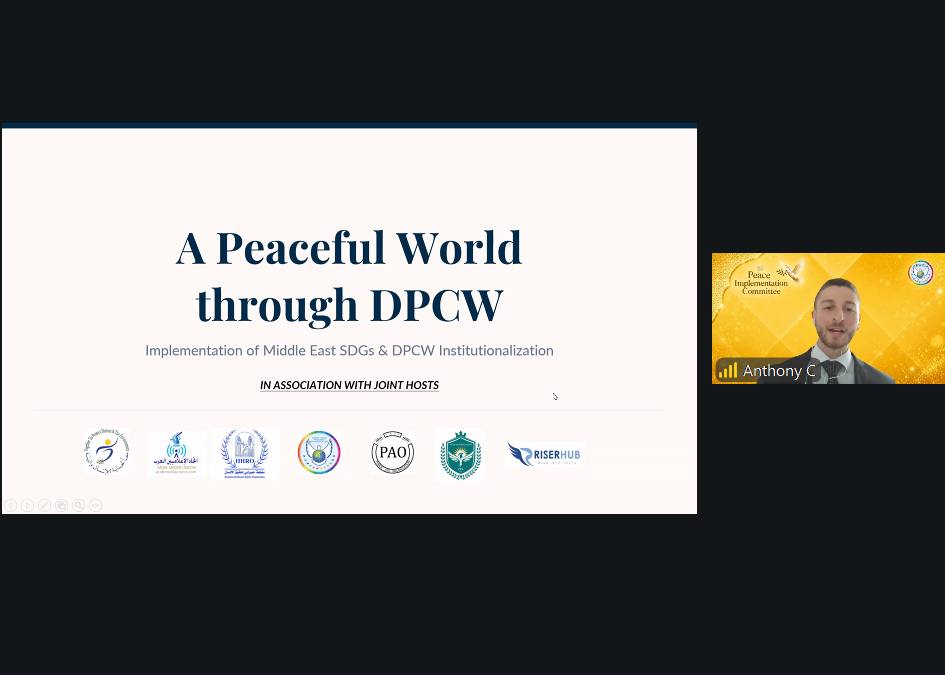
MANAMA/SEOUL: : Heavenly Culture, World Peace, Restoration of Light (HWPL) held the second Middle East Peace Committee online wherein conflict experts from Iraq and across the Middle East discuss civil society cooperation based on the DPCW.
The meeting brought together religious leaders, educators, and civil society representatives from Iraq and across the Middle East to discuss regional cooperation and the expansion of peace education based on the Declaration of Peace and Cessation of War (DPCW).
The Middle East continues to face the long-term effects of armed conflict and religious and ethnic tensions, making the restoration of social trust and the establishment of sustainable peace mechanisms ongoing regional priorities. Participants agreed that post-conflict recovery requires not only government-led efforts but also active cooperation among religious leaders, educational institutions, and civil society. They identified peace education and interfaith dialogue as practical approaches to rebuilding communities and strengthening social cohesion.
The meeting focused on Articles 8, 9, and 10 of the DPCW, covering freedom of religion, religious and ethnic identity, and the promotion of a culture of peace. Participants shared experiences from their respective countries and discussed practical applications within their local contexts. They proposed initiatives tailored to regional needs, including school-based peace education, strengthening interfaith trust, and expanding youth participation, while agreeing to continue discussions through regular committee meetings.
Former Iraqi Minister of Migration and Displacement Pascale Isho Warda said, “Today’s conflicts cannot be resolved through political approaches alone. When religious communities and civil society cooperate on the basis of shared values and mutual respect, trust can be restored within local communities. Peace is not simply the absence of war, but a society where human dignity and justice are realized together.”
Dr. Sarteep Aziz Fars, Professor at the College of Islamic Sciences, University of Sulaimani, said, “Religion exists to preserve the value of life, and interfaith dialogue is not about abandoning one’s own beliefs but about understanding others accurately and fairly. Understanding reduces fear, builds trust and cooperation, and ultimately creates the conditions in which peace can grow.”
Following the first Middle East Peace Committee meeting held in June, HWPL convened its second session to further strengthen regional cooperation. The organization plans to continue providing platforms for dialogue with civil society leaders and government stakeholders, particularly in conflict-affected countries including Iraq. Through regular forums involving local educational institutions and civil society organizations, HWPL also aims to share regional experiences and gradually expand community-based models for building a culture of peace grounded in the principles of the DPCW.
